
⚫There Is White Mold in My Reencle — Is This Normal? How Do I Prevent It?Updated 3 months ago
It depends on where the mold appears.
- Inside the unit (chamber): Usually caused by leftover food residue, overfilled/overly wet microbes, or uneven mixing — needs cleaning and a few adjustments.
- In cured compost (for garden use): Completely normal and beneficial — these are actinomycetes, helpful microorganisms that support decomposition and soil health.
1️⃣ White Mold Inside the Unit (Needs Cleaning & Adjustment)

This can happen for a few reasons:
- Food splatters onto the inner walls, lid, or mesh filter during input and isn't cleaned off, creating a surface where mold can grow.
- Small amounts of microbe residue can stick to the upper inner walls during mixing. Since this area is slightly cooler than the rest of the chamber, food particles or residue here may not fully decompose — creating a spot where white mold is more likely to appear.
- If the microbe level is too high or too wet, the stirring rod may only rotate near the bottom, leaving food at the top unprocessed and prone to mold.
- The unit was powered off while food was still inside and undecomposed. Once the temperature drops, decomposition stops — and mold can develop as a result.
- Hardware issue: If the stirring rod has stopped rotating, the unit isn't powering on, or the internal heater has malfunctioned and can no longer maintain the proper temperature, food will sit unprocessed and mold may appear. If you suspect a hardware issue, please refer to:
⁉What to do: Simply wipe or scrape the mold off the wall/lid, or push it down into the compost so it gets mixed in — Reencle's beneficial microbes are naturally strong and will typically outcompete and break down the mold. A moderate amount of mold is normal and part of the decomposition process, since our microorganism (extracted from cheese and soybean) exists comfortably alongside these common, harmless molds. Only take action if the mold is excessive. In that case, it usually means one of the causes listed above (e.g., leftover residue, overly wet microbes, stalled stirring rod, etc.) is actively affecting your unit, and worth addressing directly.
2️⃣ White Mold in Cured Compost (Normal & Beneficial)
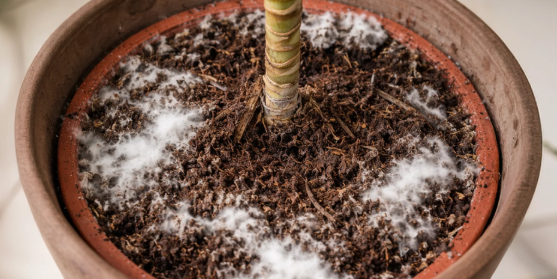
If you notice white mold while curing harvested compost for garden use, there's no need for concern — this is actinomycetes, a beneficial microorganism that helps break down tougher organic material (like lignin). Its presence is actually a positive sign of healthy, active compost — it supports soil quality and can even help suppress harmful pathogens. It's completely safe for plants.
If you'd prefer to remove it:
- If it's on top of soil in a pot/planter: Simply wipe it off.
- If it's appearing in your curing container (breathable container during the curing process): Use a shovel to mix the white mold thoroughly into the compost below. This helps it break down naturally as part of the curing process.
💡 Note: Reencle produces real, biologically active compost — not just dehydrated waste — so some level of natural microbial activity (including mild mold) is expected and part of a healthy process.