
⚫Why Do Microbes Become Wet or Clumpy?💧Updated 3 months ago
A common question: "I drained all the water from my food before adding it — why are my microbes still getting wet?"
"I only added the recommended amount — why are they getting wet anyway?"
Moisture released during the decomposition process itself is the primary cause. As food ferments and breaks down inside the chamber, water is released from within the food — regardless of surface moisture.
💡 Once fully active, healthy microbes naturally take on a soil-like form — much like garden soil.
And just like soil gets muddy after rain, this same soil-like microbe media can become temporarily wet and clumpy as food decomposes. This is a normal part of the process, not a sign of a problem on its own.
‼If moisture levels are not monitored and food or water continues to be added during this time, the microbes can become overly saturated — and in severe cases, can liquify completely.
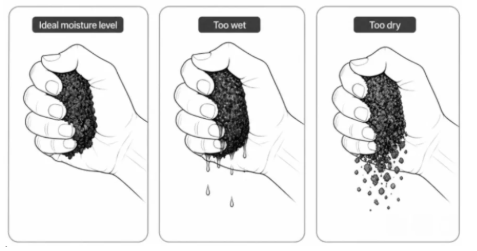
How to check moisture levels: the Squeeze Test
Take a small handful of the microbe media and squeeze it firmly in your fist. The ideal result: no water drips out, but the material just barely holds its shape. If it crumbles and falls apart completely, it's too dry. If water drips out, it's too wet.
💡 Wet microbes are not dead. Even if the microbes feel very wet or clumpy, this is a common and fully recoverable condition — not a sign that the colony has died. |
🔧 If your microbes are too wet: Follow the step-by-step recovery process here: 👉 Wet Microbe Recovery Guide
⚠️ In severe cases — such as microbes that have become fully liquified — recovery is no longer possible, and you'll need to replace them with a new Compost Starter: 🛒 Shop Compost Starter 1.0
For ongoing moisture management, refer back to this Squeeze Test regularly — checking before each feeding helps prevent moisture issues before they start.